daikon
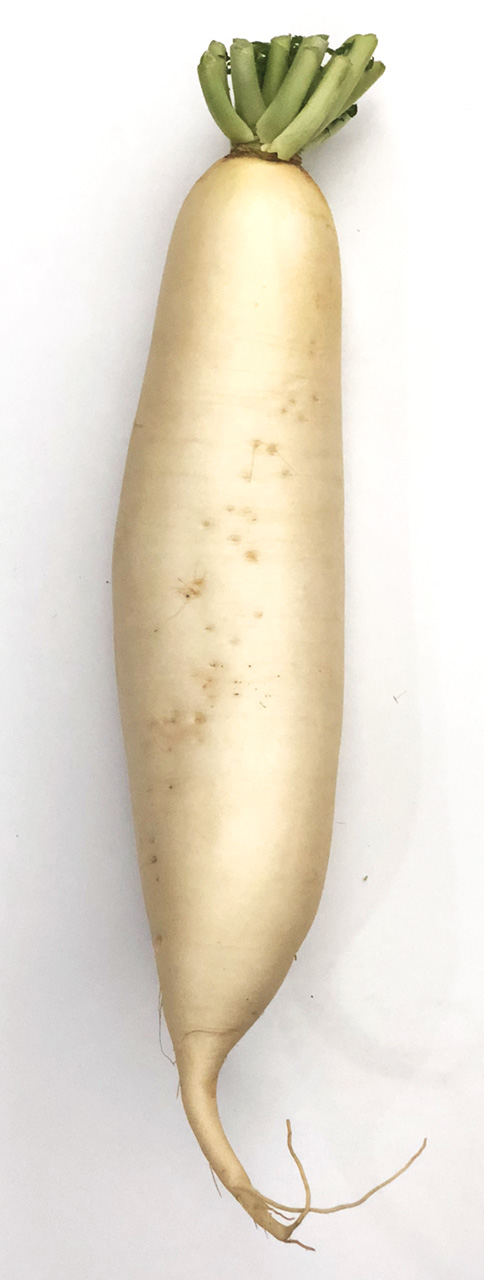
| English | daikon, daikon radish, Chinese radish, Japanese radish, Chinese turnip, robert |
| Scientific | Raphanus sativus var. longipinnatus |
|
Hong Kong
Cantonese |
蘿蔔、白蘿蔔
lo4 baak6, baak6 lo4 baak6 |
| Teochew |
菜頭, 白菜頭
cai tou/cai3 tao5 , pek cai tao |
|
Taiwan
Mandarin |
蘿蔔, 白蘿蔔, 菜頭
ㄌㄨㄛˊ ㄅㄨˇ , ㄅㄞˊ ㄌㄨㄛˊ ㄅㄨˇ , ㄘㄞˋ ㄊㄡˊ |
|
China
Mandarin |
白萝卜, 萝卜
Bái luóbo, luóbo |
| Korean |
왜무, 일본무, 남지무, 긴무, 단무지무
waemu, ilbonmu, namjimu, ginmu, danmujimu |
| Japanese |
大根 (だいこん)
daikon |
| Malay |
lobak putih
لوبق ڤوتيه |
| Tagalog | labanos |
Disambiguation
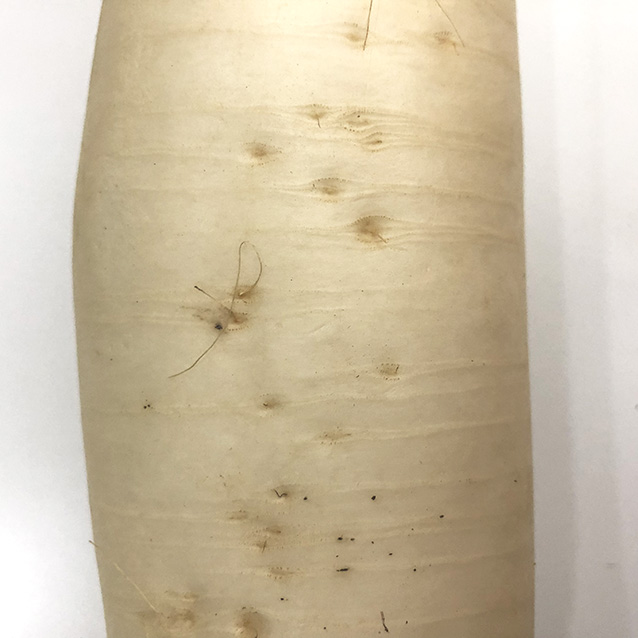
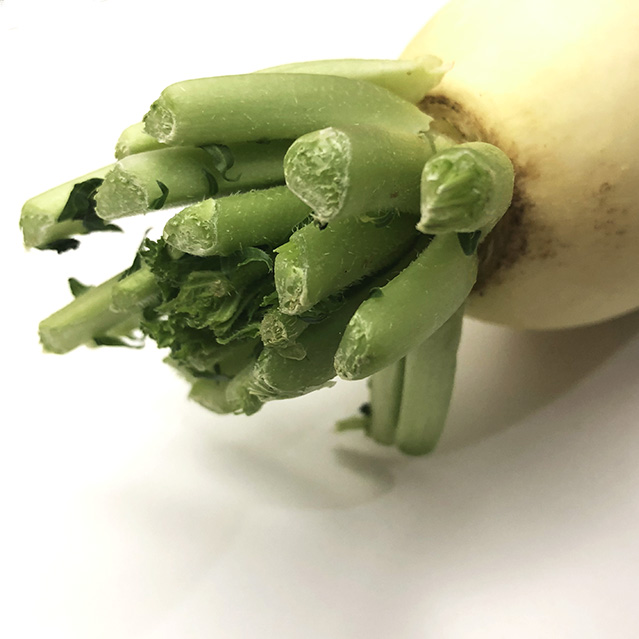
Daikons are typically beige/white. There is a common vegetable that looks like this but has a partially light-green body and a squatter body in Korea called the korean radish or mu.
In Chinese, this vegetable is commonly referred to as 蘿蔔. But the more precise term is 白蘿蔔 (white 蘿蔔). This is more precise because 紅蘿蔔 (red 蘿蔔) is a common term for carrots and 櫻桃蘿蔔 (cherry 蘿蔔) is a term for the bright red, spherical European radishes.
In Tagalog/in the Philippines, the labanos is usually thinner/more slender than the ones in Japan, but is still usually white.
We are choosing to lead with the Japanese pronunciation for this vegetable because it is a celebrated food there (see this cartoon daikon character), because Koreans call this the Japanese radish in their language, and because it's relatively easy to pronounce if you're an English speaker.